The Rhodes 22 Discussion Group
< prior
Back to Month
Go to Thread

Hank
removing tabernacle
2020-10-27; 10:38:48 EDT
Member Since
2004-10-28
Posts: 1564
Here's another article.

https://www.boatingmag.com/marine-solvents-for-removing-5200/

Hank
See the original archive post
On Tue, Oct 27, 2020 at 10:38 AM ROGER PIHLAJA <roger_pihlaja at msn.com>
wrote:

> Hi Jesse,
>
> The attached article is from the Dec 13, 2016 issue of Practical Sailor
> magazine.  Based on their testing, they recommend Re-Mov and BoatLife
> Release for breaking the polyurethane adhesive bond between metal and
> gelcoat.  Neither product worked very fast on polyurethane and required
> repeated applications and some scraping.  I have no personal experience
> with either product.  Good Luck!
>
> Roger Pihlaja
> S/V Dynamic Equilibrium
>
> PS Tests Adhesive Removers
>
> Re-Mov gives 100% bond strength after silicone removal.
> estaff
> Published:December 13, 2016
> 0<
> https://www.practical-sailor.com/boat-maintenance/ps-tests-adhesive-removers#respond
> >
> <
> https://www.facebook.com/sharer.php?u=https%3A%2F%2Fwww.practical-sailor.com%2Fboat-maintenance%2Fps-tests-adhesive-removers
> >
> <
> https://twitter.com/intent/tweet?text=PS+Tests+Adhesive+Removers&url=https%3A%2F%2Fwww.practical-sailor.com%2Fboat-maintenance%2Fps-tests-adhesive-removers&via=Practical+Sailor
> >
> <mailto:?subject=PS%20Tests%20Adhesive%20Removers&body=
> https://www.practical-sailor.com/boat-maintenance/ps-tests-adhesive-removers
> >
> <
> https://www.practical-sailor.com/boat-maintenance/ps-tests-adhesive-removers
> >
>
> [cid:image001.jpg at 01D6AC4C.102C9EE0]<
> https://s30384.pcdn.co/wp-content/uploads/2019/09/p1b3sc94ue13941ps41g391aka1c586.jpg
> >
>
> Many years ago, one of our editors had an old wooden boat with lovely
> wooden handrails just inside the companionway that his sailing partner
> decided could use new varnish. The original coat, which was peeling around
> the base and worn where hands had gripped it, was sanded smooth and
> meticulously coated with varnish. Subsequent coats were applied according
> to the process that had served well for years-varnish, scuff, wipe,
> varnish, scuff, wipe . . . repeat.
> [aluminum hatch]
>
> The handrails looked beautiful, until about a week later when wrinkling,
> peeling, and lifting was noticed at the base. The problem was blamed on the
> varnish, a local brand purchased in Cartagena, Colombia, where the boat was
> at the time. The handrails were left alone until they could track down a
> more reputable varnish. When it failed the same way, it became obvious that
> the varnish was not at fault. Only later did they discover that the
> handrails, installed by a previous owner, had at one point been bedded in
> silicone caulk. Even with all the sanding and prepping, enough traces
> remained to interfere with the adhesion of the varnish at the base.
>
> Silicone caulk is notorious for wreaking havoc with the adhesion of
> sealants and paint. In fact, you will probably find that new silicone
> bedding does not bond well to surfaces that have been supposedly scrubbed
> clean. The trouble is that old silicone can be deeply embedded in the pores
> of gelcoat and wood, invisible to the naked eye.
>
> Instead of silicone, many boaters prefer polyurethane, polysulfide (not
> compatible with acrylic or Lexan), and butyl caulks because they last
> longer, leak less, and do not leave behind a residue that will hinder
> adhesion. But as we saw in our recent report on caulks (see Marine Sealant
> Adhesion Test, PS December 2016 online), silicone is a versatile sealant
> and is particularly effective when sealing glazing for portlights and
> hatches.
>
> The retreat to polyurethane adhesive sealants, such as 3M 5200, raises
> another bonding issue. They work too good. As weve seen in a number of
> previous tests, 3M 5200-considered by many to be the gold standard for
> bedding underwater fittings-is not the best choice for fittings that you
> may want to re-bed.
>
> What many people don't realize is that 3M 5200 is considered a
> semi-permanent adhesive-sealant with an emphasis on adhesive. Its grip is
> so tenacious that it can pull gelcoat right off the deck when hardware is
> pried loose. It is particularly well suited for through-hulls, but for
> bedding most deck hardware, there are better solutions. (See The Great
> Stickup: Practical Sailor Tests Marine Adhesives, Caulks, and Sealants<
> http://www.practical-sailor.com/issues/36_8/features/Marine-Adhesives-Caulks_5953-1.html>,
> PS August 2010 online.)
>
> Pondering the adhesive-sealant conundrum, the same questions kept coming
> back to us. Can we still use silicone products for those jobs that they do
> best, like sealing plastic and glass glazing, without jeopardizing future
> repairs? Is there not a solvent that would remove the silicone residue when
> it came time to varnish or re-bed? And what about removing 5200 or similar
> high-strength adhesives? Would any solvent that is aggressive enough to
> soften these caulks also damage the substrate?
>
> What We Tested
>
> To answer these questions, we mounted a product test of adhesive removers.
> The test field included the obvious choices, xylene and acetone-solvents
> commonly used in the marine industry for removing contaminants and prepping
> surfaces for new paint-from the familiar hardware-store brand Kleen Strip.
>
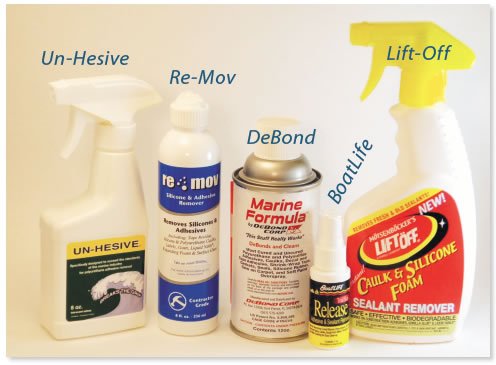
> The focus of the test field were five products that makers claim will
> remove any trace of silicone and polyurethane caulks: BoatLife Release,
> designed to simplify the removal of a wide range of adhesives; Marine
> Formula DeBond, a patented chemical product to remove polyurethane
> adhesive-sealants such as 3M 5200; Un-Hesive, another patented product used
> to remove cured polyurethane adhesive; Re-Mov, a product that claims to
> break the bond of most commercial adhesives; and Lift-Off Silicone Caulk
> and Foam Sealant Remover (FSR), from Motsenbocker, a company that offers a
> wide range of adhesive removers.
>
> None of the products we tested claim to dissolve the caulk, they simply
> break the bond with the substrate. All suggest that the process may require
> several applications and a specific dwell time (wait period before scraping
> or re-application) of up to 30 minutes.
>
> How We Tested
>
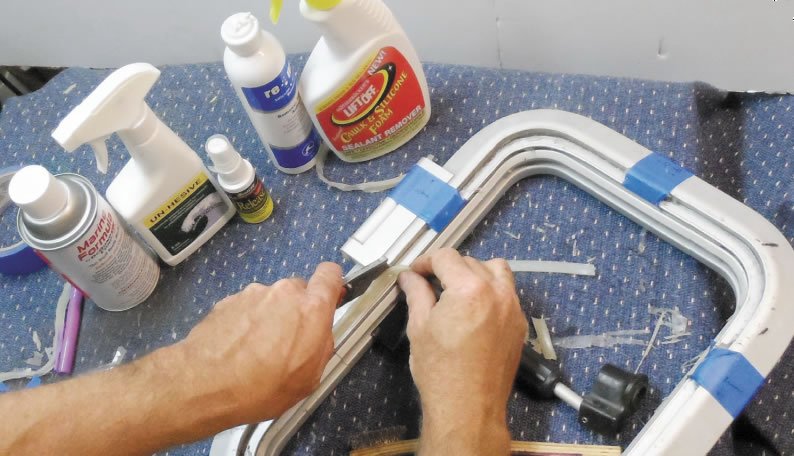
> Our first test was simply to compare ease of use, to see how quickly and
> easily they removed the visible remnants of silicone. For this, we used a
> hatch that was in need of a lens replacement.
>
> We applied each product to a taped-off section of the hatch and allowed it
> to soak, according to the instructions. We then followed the makers
> instructions, following the chemical application with tools designed to
> help physically break the bond. We used tools that have served well on
> similar projects, a razor knife, a wire brush, and a hose hook, which
> resembles a bent ice pick. (See Hose Fitting Tips<
> http://www.practical-sailor.com/issues/37_65/features/Hose-Fitting-Tips_11997-1.html>,
> PS May 2016 online.) After comparing the performance on the six taped-off
> sections, we used the most effective product to clean the entire frame and
> set it aside for reglazing. The reglazed hatch will be incorporated into a
> long-term test against untreated controls to determine whether
> acrylic/aluminum adhesion is in any way compromised or improved over time.
>
> To test the removers debonding effectiveness on gelcoated surfaces (as
> well as any potential harm to gelcoat), we covered six gelcoated,
> 1/8-inch-thick fiberglass coupons with a thin layer of 3M Marine Silicone
> Caulk. Six other identical coupons were coated with 3M 4200 Fast Cure
> polyurethane caulk. Testers let the bonded coupons cure for six weeks, then
> treated each coupon with an adhesive remover, making three applications 30
> minutes apart. We examined the samples after each application, gently
> testing adhesion.
>
> After the final application of each product, we began scraping one side of
> each coupon with a plastic scraper to compare ease of removal. If we were
> able to remove most of the caulk from a coupon, we cleaned more
> aggressively using a wire brush by hand. We then added a second application
> of the same caulk remover, and finally, we cleaned the coupon with soap and
> water. Any coupon that came reasonably clean was then bonded to an
> identical, untreated coupon using either 3M Marine Silicone or 3M 4200.
>
> Observations
>
> Neither acetone nor xylene had any measurable effect on either silicone or
> polyurethane, so that is all well say about them here. On the aluminum
> hatch frame, all five of the dedicated caulk removers significantly
> weakened the bond of the silicone caulk and helped reduce prep time, but
> Re-Mov performed the best. We used Re-Mov to do the final cleaning on our
> aluminum hatch frame and were impressed with the result.
>
> On the fiberglass/gelcoat coupons, BoatLife Release, DeBond, and Re-Mov
> softened the silicone and loosened the edges after the initial treatment
> and scraping. However, when we began scraping the coupons with a soft
> plastic scraper after the second treatment, the Re-Mov sample was clean
> after just a few strokes, with only traces of silicone remaining. A third
> application of Re-Mov and a little scrubbing with a regular toothbrush
> removed 100 percent of the remaining caulk.
>
> BoatLife Release made it much easier to scrape away the silicone caulk,
> but considerable residue was left in the depressions. Even after
> retreatment with BoatLife Release and vigorous scrubbing, it was clear that
> only aggressive and potentially damaging methods such as a wire brush or
> grinding would remove the rest of the silicone. In the end, only the Re-Mov
> and BoatLife Release coupons advanced to the bonding test.
>
> Although vendors claimed their products were highly effective on
> polyurethanes, our experience didn't match the claims. After the first
> application to the fiberglass coupons, we saw little change in adhesion.
> However, after repeated applications 15 to 30 minutes apart, we met
> success. With the aid of a razor knife and some hand scrubbing with a wire
> brush, Re-Mov and BoatLife Release were able to get down to a bare surface
> with minimal gelcoat damage. Of the two, the BoatLife Release was the most
> effective on polyurethane.
>
> We also tried using the test products to release the bond between of two
> of our sample gelcoat/ fiberglass coupons bonded with high-strength
> polyurethanes. No matter which product we used, the samples simply could
> not be separated without breaking the relatively fragile coupons.
>
> After test-followup conversations with some adhesive-remover makers, weve
> decided to re-test all of the products on fiberglass-to-fiberglass bonds
> made with 3Ms 5200. Look for an update on these results in an upcoming
> issue.
>
> All of the products were more effective at breaking the bond between
> polyurethane adhesive and aluminum. Two polyurethane adhesives, 3M 5200 and
> 3M 4200, could be released from aluminum using any of the removers.
> However, none of the products could break the bond between aluminum and
> Loctite PL S40 or Loctite Marine Caulk.
>
> Our final test proved that at least one product could remove silicone
> without compromising subsequent adhesion. The fiberglass/gelcoat coupons
> that had been treated with Re-Mov and BoatLife Release were thoroughly
> scrubbed and washed with soap and water and then bonded to identical,
> untreated textured gelcoat/fiberglass coupons. The samples were allowed
> cure for eight weeks and then pulled to failure. The BoatLife Release
> yielded results that fell short of the bond strength between untreated
> surfaces, but Re-Mov impressed us by restoring full bond strength to the
> silicone-contaminated surface.
>
> BoatLife Release
>
> This product comes in a convenient spray bottle and is advertised for its
> ability to remove cured sealants from fiberglass, wood, metal, and glass.
> It also is supposed to work on residue from decals, tapes, labels, and
> other adhesives, and is safe to use on most carpeted, vinyl, plastic, and
> painted surfaces. When attacking the aluminum hatch and the textured
> fiberglass samples, BoatLife Release quickly softened the caulk, and some
> of it began peeling. But after three applications, 15 minutes apart, it was
> clear that it wasnt releasing the bond completely, and that aggressive
> cleaning with a wire brush would be needed. It was moderately effective on
> polyurethane.
>
> Bottom line: BoatLife Release is recommended for tough jobs involving
> polyurethane. It finished in second place for overall performance.
>
> Motsenbocker Lift-Off
>
> Motsenbackers Lift-Off Silicone Caulk and Foam Spray Remover comes in a
> spray bottle, but it is a gelled liquid that must be spread around with a
> brush or plastic spreader. It was more effective than xylene and acetone
> when cleaning the aluminum hatch frame, but was completely ineffective on
> textured fiberglass.
>
> Bottom line: Lift-Off does not compare well to other products in this
> category.
> [cid:image001.jpg at 01D6AC4C.102C9EE0]
> Re-Mov Silicone and Adhesive Remover
>
> This remover was our most effective overall for removing both silicone
> caulk residue and polyurethane adhesive. According to the maker, Re-Mov
> will debond polyurethane-bedded hardware even if it has been in place for
> years. While we found it a bit slower acting than other products, the end
> results were truly impressive. Two applications, 15 minutes apart, a few
> quick passes with a plastic scraper, 20 seconds scrubbing with a bristle
> brush, and a good wash with soap and water, eliminated all the silicone
> from a textured deck, allowing it to match original bond strength.
>
> If we had a bonding or coating job in which silicone contamination of the
> surface was suspected, this would be our antidote. Polyurethane caulk was a
> tougher challenge, but it did allow us to remove the caulk without damaging
> the gelcoat.
>
> Bottom line: Re-Mov is the PS Best Choice and Budget Buy for removing
> silicone or polyurethane caulk.
>
> Un-Hesive
>
> Un-Hesive is advertised to be specifically formulated to release the bond
> of extremely potent polyurethane adhesive sealants such as 3M 5200 and
> Sikaflex. Makers claim it breaks the grip of these polyurethane adhesives
> without material breakdown. It is meant to be sprayed on, and the cured
> sealant is to be easily peeled off. Our own experience fell short of
> expectations.
>
> Bottom line: Un-Hesive made it easier to clean the aluminum hatch, but its
> poor performance on textured fiberglass dulled our enthusiasm. It was not
> effective on polyurethane caulk.
>
> DeBond
>
> The lone aerosol in the group, Marine Formula DeBond is the signature
> product of DeBond Corp., one of the first companies to put these types of
> products into the hands of do-it-yourselfers. DeBonds claims specifically
> targeted 3M 5200. In our tests, it helped a little when dealing with
> silicone caulk, but it was not very effective on polyurethane.
>
> Bottom line: Were withholding a final rating on DeBond pending the results
> of our 5200/fiberglass re-test.
>
> Conclusion
>
> Based on our experience with a couple of these products, we see no good
> reason to ban silicone from the boat, or to rev up the grinder every time
> you pull up a 5200-bedded stanchion. Re-Mov is the clear winner in the
> silicone-caulk removal category, but youll need a little patience. Wait 15
> to 25 minutes before attacking the adhesive with a scraper. If
> polyurethanes are the bane of your current project, reach for the BoatLife
> Release, but expect that it is still going to be hard work, with
> considerable scraping and other mechanical efforts to remove the final
> traces.
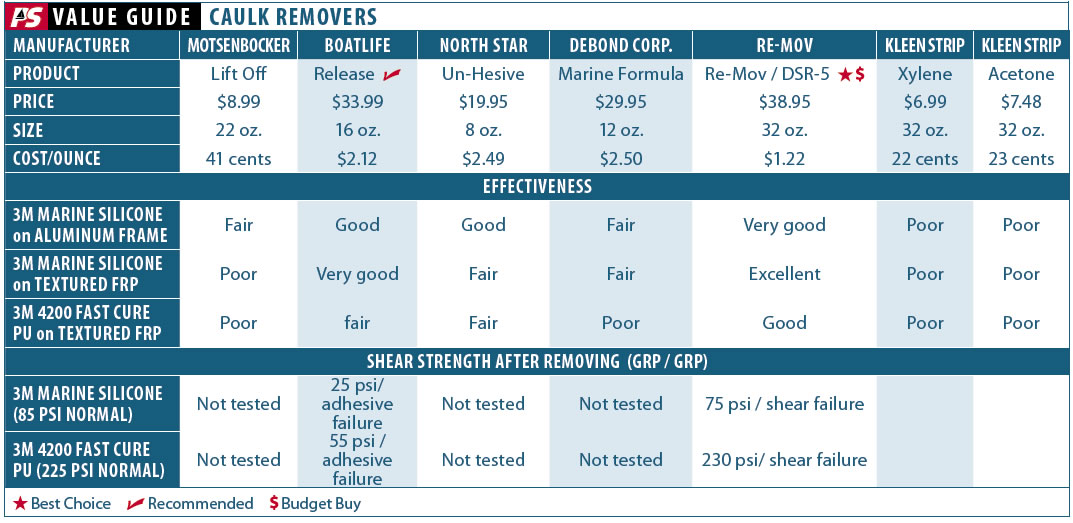
> Caulk Removers
> [cid:image003.jpg at 01D6AC4C.102C9EE0]
> Contacts
> ·        Boatlife<http://www.boatlife.com/>
> ·        DeBond<http://www.debondcorporation.com/>
> ·        Motsenbocker<http://www.liftoffinc.com/>
> ·        North Star<http://www.un-hesive.com/>
> ·        Re-Mov<http://www.re-mov.com/>
>
>
> Sent from Mail<https://go.microsoft.com/fwlink/?LinkId=550986> for
> Windows 10
>
> From: Jesse Shumaker<mailto:jesse.laten.shumaker at gmail.com>
> Sent: Monday, October 26, 2020 9:51 PM
> To: The Rhodes 22 Email List<mailto:rhodes22-list at rhodes22.org>
> Subject: [Rhodes22-list] removing tabernacle
>
> Hi, I'm attempting to remove the mast tabernacle in order to install the
> Dwyer Halyard Organizer plate (part DH288).  The three screws came out
> easily, but the tabernacle is still attached very strongly with an
> adhesive.  I don't know what adhesive was used.  The adhesive is colored
> white.  I tried heating up the plate with a soldering iron and tried to
> squeeze in a razor but have been unable to break the seal.
>
> I would appreciate any tips from the group on how to free the tabernacle
> from the cabin top.  Thanks in advance for any advice!
>
> Jesse Shumaker
> S/V Zephyr
>
> -------------- next part --------------
> A non-text attachment was scrubbed...
> Name: 4E1D0A3AF09C4F93BFB5A230C468B0CA.jpg
> Type: image/jpeg
> Size: 35407 bytes
> Desc: 4E1D0A3AF09C4F93BFB5A230C468B0CA.jpg
> URL: <
> http://rhodes22.org/pipermail/rhodes22-list/attachments/20201027/2fa3e4dd/attachment.jpg
> >
> -------------- next part --------------
> A non-text attachment was scrubbed...
> Name: E59E01FBC1034C7AB266607A62717808.jpg
> Type: image/jpeg
> Size: 81188 bytes
> Desc: E59E01FBC1034C7AB266607A62717808.jpg
> URL: <
> http://rhodes22.org/pipermail/rhodes22-list/attachments/20201027/2fa3e4dd/attachment-0001.jpg
> >
> -------------- next part --------------
> A non-text attachment was scrubbed...
> Name: F79E75072ADC44FC883FBEF1EC725EE3.jpg
> Type: image/jpeg
> Size: 146922 bytes
> Desc: F79E75072ADC44FC883FBEF1EC725EE3.jpg
> URL: <
> http://rhodes22.org/pipermail/rhodes22-list/attachments/20201027/2fa3e4dd/attachment-0002.jpg
> >
>

Message to Webmaster:
To use your email application to send a messsage to the webmaster rather than this form, .
Post to the Rhodes 22 Email List:
Sending Post:
Your post is being sent... 